 Fluentd
Install calyptia-fluentd by .msi Installer (Windows)
What is calyptia-fluentd?
calyptia-fluentd is the alternative distribution of Fluentd.
- Includes Ruby and other library dependencies (since most Windows boxes are not installed).
- Includes a set of frequently-used 3rd party plugins such as
out_elasticsearchandin_windows_eventlog2. - This alternative agent is developed by Chronosphere after its acquisition of Calyptia.
Currently, calyptia-fluentd is on v1 only.
calyptia-fluentdv1 packages Fluentd 1.12.x (or later).
How to install calyptia-fluentd v1
Step 1: Install calyptia-fluentd
Download the latest MSI installer from the download page. Run the installer and follow the wizard.
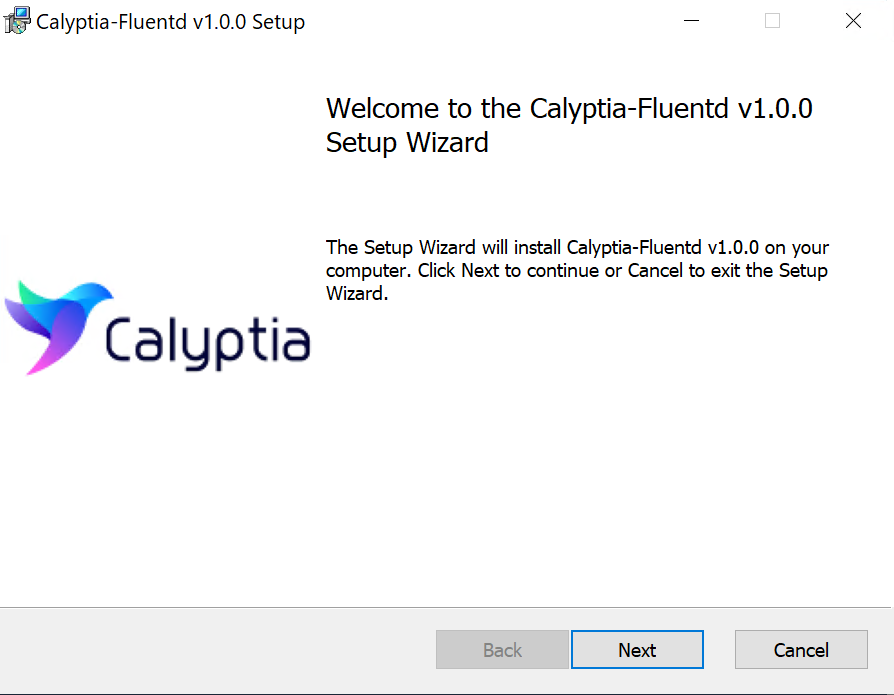
Note: Calyptia-Fluentd is a drop-in-replacement agent of other Fluentd stable distribution. Currently, we use the same Windows Service name which is fluentdwinsvc. This is because when you already installed other agent which registers Windows Service as fluentdwinsvc, you must uninstall already installed Windows Service which uses fluentdwinsvc as service name.
Step 2: Set up calyptia-fluentd.conf
Open C:/opt/calyptia-fluentd/etc/calyptia-fluentd/calyptia-fluentd.conf with a text editor. Replace the configuration with the following content:
<source>
  @type windows_eventlog2
  @id windows_eventlog2
  channels application
  read_existing_events false
  tag winevt.raw
  rate_limit 200
  <storage>
    @type local
    persistent true
    path C:\opt\td-agent\winlog.json
  </storage>
</source>

<match winevt.raw>
  @type stdout
</match>
Step 3: Launch Calyptia-Fluentd Command Prompt
Open Windows Start menu, and search Calyptia-fluentd Command Prompt. In most environments, the program will be found right under the "Recently Added" section.
Calyptia-fluentd Command Prompt is basically cmd.exe, with a few PATH tweaks for calyptia-fluentd programs. Use this program whenever you need to interact with calyptia-fluentd.
Step 4: Run calyptia-fluentd
Type the following command into Calyptia-fluentd Command Prompt:
C:\opt\calyptia-fluentd> calyptia-fluentd
Now calyptia-fluentd starts listening to Windows Eventlog, and will print records to stdout after consuming Windows EventLog Events on Application channel.
Step 5: Run calyptia-fluentd as Windows service
As of first released version, calyptia-fluentd will register as a Windows service as fluentdwinsvc by the msi installer. Also, You can manage calyptia-fluentd service manually.
Using GUI
Please guide yourself to Control Panel -> System and Security -> Administrative Tools -> Services, and you'll see Fluentd Windows Service is listed.
Please double click Fluentd Window Service, and click Start button. Then the process will be executed as Windows Service.
Using net.exe
> net start fluentdwinsvc
The Fluentd Windows Service service is starting..
The Fluentd Windows Service service was started successfully.
Using Powershell Cmdlet
PS> Start-Service fluentdwinsvc
Note that using fluentdwinsvc is needed to start Fluentd service from the command-line. fluentdwinsvc is the service name and it should be passed to net.exe or Start-Service Cmdlet.
The log file will be located at C:/opt/calyptia-fluentd/calyptia-fluentd.log as we specified in Step 3.
Step 6: Install Plugins
Open Calyptia-fluentd Command Prompt and use calyptia-fluentd-gem command as Administrator:
C:\opt\calyptia-fluentd> calyptia-fluentd-gem install fluent-plugin-xyz --version=1.2.3
Next Steps
You are now ready to collect real logs with Fluentd. Refer to the following tutorials on how to collect data from various sources:
- Basic Configuration
- Application Logs
- Examples