 Fluentd
Cep Norikra
This article explains how to use Fluentd and Norikra to create a SQL-based real-time complex event processing platform.
Background
Fluentd is an advanced open-source log collector originally developed at Treasure Data, Inc. Fluentd is not only a log collector, but also an all-purpose stream processing platform. Plugins can be written to handle many kinds of events.
However, Fluentd is not primarily designed for stream processing. We must restart Fluentd after making modifications to its configuration/code, making it unsuitable for running both short-span (seconds or minutes) calculations and long-span (hours or days) calculations. If we restart Fluentd to perform a short-span calculation, all existing internal statuses of short and long span calculations are lost. For large scale stream processing platforms, code/processes must be added/removed without any such losses.
Norikra is an open-source stream processing server based on Esper by EsperTech. It allows you to subscribe/unsubscribe to data streams anytime and add/remove SQL queries anytime. Norikra is written by tagomoris, a committer of the Fluentd project.
This article will show you how to integrate Fluentd, Norikra, and the Fluentd norikra plugin to create a robust stream data processing platform.
Architecture
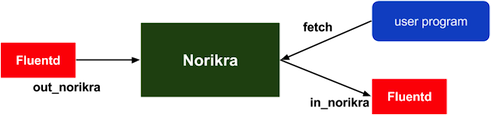
The figure below shows the high-level architecture.
Installation
For the sake of simplicity, this guide will set up a one-node configuration. Please install the following on the same node:
Installing Fluentd and fluentd-plugin-norikra
Fluentd can be installed through rubygems or via deb/rpm packages.
fluent-plugin-norikra can be installed with the gem install fluent-plugin-norikra (or fluent-gem) command.
Installing Norikra
Norikra requires JRuby. You can download the JRuby binary directly from the official site and export the PATH of JRUBY_INSTALL_DIRECTORY/bin.
Once JRuby has been installed, simply entering jgem install norikra will install Norikra.
Verify Installation
We'll start the Norikra server after installation. The norikra start command will launch the Norikra server in your console.
....
2014-05-20 20:36:01 +0900 [INFO] : Loading UDF plugins
2014-05-20 20:36:01 +0900 [INFO] : RPC server 0.0.0.0:26571, 2 threads
2014-05-20 20:36:01 +0900 [INFO] : WebUI server 0.0.0.0:26578, 2 threads
2014-05-20 20:36:01 +0900 [INFO] : Norikra server started.
You can also check the current Norikra's status via the WebUI (http://localhost:26578/).
Fluentd Configuration
We'll now configure Fluentd. If you used the deb/rpm package, Fluentd's config file is located at /etc/td-agent/td-agent.conf. Otherwise, it is located at /etc/fluentd/fluentd.conf.
HTTP Input
For the input source, we will set up Fluentd to accept records from HTTP. The Fluentd configuration file should look like this:
<source>
  @type http
  port 8888
</source>
Norikra Output
The output destination will be Norikra. The output configuration should look like this:
<match data.*>
  @type    norikra
  norikra localhost:26571
  target_map_tag    true
  remove_tag_prefix data

  <default>
    include *
    exclude time
  </default>
</match>
The match section specifies the glob pattern used to look for matching tags. If a matching tag is found in a log, then the config inside <match>...</match> is used (i.e. the log is routed according to the config inside).
The norikra attribute specifies the Norikra server's RPC host and port ('26571' is the default port of Norikra RPC protocol). By target_map_tag true and remove_tag_prefix data, out_norikra handle the rest of tags (ex: 'foo' for 'data.foo') as target, which is a name of set of events as same as table name of RDBMS.
The <default>...</default> section specifies which fields are sent to the Norikra server. We can also specify these sets per target with <target NAME>...</target>. For information on the additional options available, please refer to the fluent-plugin-norikra documentation.
Test
To test the configuration, just post the JSON to Fluentd (we use the curl command in this example).
$ curl -X POST -d 'json={"action":"login","user":2}' \
  http://localhost:8888/data.access
Norikra's console log will show that Fluentd has opened the target access and sent a message with fields of action and user.
2014-05-20 20:43:22 +0900 [INFO] : opening target, target:"access", fields:{}, auto_field:true
2014-05-20 20:43:23 +0900 [INFO] : opening lazy target, target:#<Norikra::Target:0x69c04611 @last_modified=nil, @fields={}, @name="access", @auto_field=true>
2014-05-20 20:43:23 +0900 [INFO] : target successfully opened (snip)
We can check its fields with the norikra-client command (from console that has the PATH to JRuby).
$ norikra-client target list
TARGET  AUTO_FIELD
access  true
1 targets found.
$ norikra-client field list access
FIELD   TYPE    OPTIONAL
action  string  false
user    integer false
2 fields found.
Registering Queries and Fetching Outputs
We can add queries on opened targets via the WebUI or CLI. The following query (just SQL!) counts the number of events with a non-zero user per 10 second interval, with a 'group by' action.
SELECT
  action,
  count(*) AS c
FROM access.win:time_batch(10 sec)
WHERE user != 0
GROUP BY action
To register a query, issue norikra-client query add on the CLI.
$ norikra-client query add test_query "SELECT action, count(*) AS c FROM access.win:time_batch(10 sec) WHERE user != 0 GROUP BY action"
$ norikra-client query list
NAME    GROUP   TARGETS QUERY
test_query  default access  SELECT action, count(*) AS c FROM access.win:time_batch(10 sec) WHERE user != 0 GROUP BY action
1 queries found.
Once the query has been registered, post the events that you want.
$ curl -X POST -d 'json={"action":"login","user":2}' \
  http://localhost:8888/data.access
$ curl -X POST -d 'json={"action":"login","user":0}' \
  http://localhost:8888/data.access
$ curl -X POST -d 'json={"action":"write","user":2}' \
  http://localhost:8888/data.access
$ curl -X POST -d 'json={"action":"save","user":2}' \
  http://localhost:8888/data.access
$ curl -X POST -d 'json={"action":"logout","user":2}' \
  http://localhost:8888/data.access
$ curl -X POST -d 'json={"action":"logout","user":0}' \
  http://localhost:8888/data.access
$ curl -X POST -d 'json={"action":"login","user":2}' \
  http://localhost:8888/data.access
And fetch output events from this test_query query.
$ norikra-client event fetch test_query
{"time":"2014/05/20 21:00:24","c":1,"action":"logout"}
{"time":"2014/05/20 21:00:24","c":1,"action":"save"}
{"time":"2014/05/20 21:00:24","c":1,"action":"write"}
{"time":"2014/05/20 21:00:24","c":2,"action":"login"}
{"time":"2014/05/20 21:00:34","c":0,"action":"logout"}
{"time":"2014/05/20 21:00:34","c":0,"action":"save"}
{"time":"2014/05/20 21:00:34","c":0,"action":"write"}
{"time":"2014/05/20 21:00:34","c":0,"action":"login"}
$
If posts are done in 10 seconds, this query calculates all events in first 10 seconds, and counts events per action for events with user != 0 only, and outputs events at "2014/05/20 21:00:24". At "2014/05/20 21:00:34", just after next 10 seconds, this query reports that no events arrived (This is teardown records, and reported only once).
Conclusion
We can create a stream data processing platform without any schema definitions, using Fluentd and Norikra. This platform enables an agile stream processing environment that can handle real workloads.
Learn More
- Fluentd Architecture
- Fluentd Get Started
- Norikra: Query Syntax
- Norikra: Query Examples
- Slides: fluent-plugin-norikra
If this article is incorrect or outdated, or omits critical information, please let us know. Fluentd is a open source project under Cloud Native Computing Foundation (CNCF). All components are available under the Apache 2 License.